Medieval history is full of fascinating journeys, especially those by 12th-century Jewish travelers. Petachia of Regensburg presents a unique perspective on Jewish life in Europe and the Middle East. This contrasts with the travelogue of Benjamin of Tudela, who is more widely recognized.
Glatt Kosher Vacations Designed With Purpose
Kosher river cruises offer travelers a mix of cultural insight and comfort. Enjoy fine kosher dining, daily services, and curated itineraries. A kosher river cruise turns your glatt kosher vacation into a meaningful journey through history.
Why Is Petachia Less Famous Than Benjamin of Tudela?
Benjamin of Tudela’s accounts are studied for their detailed views of Jewish communities and their lives. Petachia is often seen as the “other 12th-century Jewish traveler.”
Though overshadowed by Benjamin, Petachia’s accounts offer equally valuable insights. His observations show different aspects of the same communities. This gives readers a clearer view of Jewish life in the late 1100s.
What Do We Know About Petachia’s Family and Background?
Petachia came from the Halavan family, a rare surname for his time. His father, Jacob Halavan, and brother, Yitzhak Ben Jacob Halavan, were part of the Baletosfos school. This group was key for Talmudic commentary.
Petachia didn’t write Talmudic commentary. Still, his religious upbringing likely influenced his travels, giving them a spiritual focus.
Who Recorded Petachia’s Travels?
Unlike Benjamin of Tudela, Petachia did not write his travelogue. Rabbi Huda Hasid, a key figure in the 12th-century Haside Ashkenaz movement, shared his stories. This movement greatly influenced Jewish communities in Northern Europe. Petachia’s travels are in the Sivov, or “The Circle.” It details his journey through Eastern Europe and the Eastern Mediterranean.
What Was the Purpose of Petachia’s Travels?
Petachia was a rich traveler. This wealth was key for long journeys in the 12th century. His travels required resources, social connections, and a way to engage with Jewish communities on the journey.
While wealth was important, his main goal was religious. He wanted to visit sacred sites in Israel and Babylonia. This showed his strong bond with Jewish scholarship and spirituality.
What Route Did Petachia Follow?
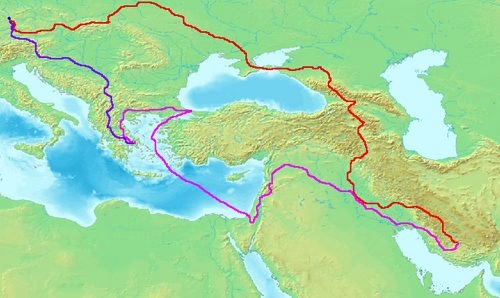
Petachia likely began in Prague, a city he was close to. He then traveled through present-day Ukraine and Crimea. After that, he crossed the Caucasus and reached Babylonia. His observations were compelling for European readers. They highlighted a vibrant Jewish community with yeshivot and solid political structures. This included the Rash Galusa (Exarch), the community leader.
He started in Babylonia and followed Abraham’s historic path. He traveled through southern Mesopotamia by the Persian Gulf, then into Syria, and finally reached the Land of Israel.
What Did Petachia Observe in the Land of Israel?
Petachia’s accounts of post-Crusader Israel differ greatly from his observations in Babylonia. After the Crusader attacks starting in 1099, Jewish communities suffered significant devastation. In Jerusalem, he found only one Jewish resident, Abraham the Dyer, tolerated for his trade with the Crusaders. Across the region, Jewish settlements were sparse and struggling.
How Was Petachia’s Sivov Preserved and Published?
The Sivov was first published in Prague in 1595, long after Petachia’s journey. Its popularity resulted in over 24 editions and translations into at least six languages, like English. Petachia’s observations are important in Jewish historical scholarship. This ongoing interest highlights that significance.
Why Is Petachia of Regensburg Important Today?
Petachia’s travels give a valuable glimpse into 12th-century Jewish life in Europe and the Middle East. His journey highlights the contrast between thriving Jewish communities in Babylonia and the devastation in post-Crusader Israel. His account also reflects the enduring human curiosity and spiritual devotion that have inspired travelers for centuries.
Petachia’s story reminds modern audiences of the depth of Jewish history. It shows us why we must preserve these important narratives. His observations continue to enhance scholars and those curious about the lives of medieval Jewish communities.
Extending Jewish Learning Beyond the Page With Kosher River Cruise

Studying Jewish history naturally sparks curiosity and exploration. A glatt kosher vacation lets travelers turn curiosity into real experiences. They can visit important sites up close. Kosher river cruises celebrate Jewish heritage. They create a space for reflection, connection, and learning.

He is a scholar known for his sophisticated yet accessible lectures on Jewish history, watched by thousands of viewers daily on YouTube. The author of seven books on Jewish history and thought, he earned his PhD from the University of Toronto and held visiting and post-doctoral positions at Harvard, Cornell, Oxford and the Hebrew University of Jerusalem.