Among the sacred garments described in the Torah, few are as mysterious as the Ephod. In Parashat Tsav and related sections about the priestly service, the Ephod is one of the key garments of the High Priest. Yet despite its importance, the exact meaning of the word remains uncertain.
Unlike many Hebrew words, “Ephod” usually stays untranslated in English Bibles and Jewish texts. Scholars and historians still debate the garment’s appearance and how it was worn. The word was likely tied to its culture in the ancient world. Later generations may not have fully grasped its meaning.
The Ephod is one of the most intriguing objects in Jewish history and biblical studies. This uncertainty adds to its allure.
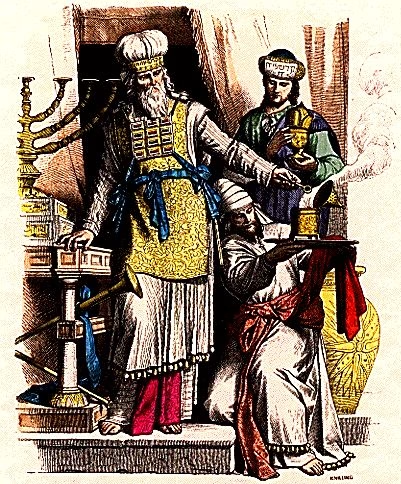
By THE HISTORY OF COSTUME By Braun & Schneider – https://www.siue.edu/COSTUMES/history.html, Public Domain, https://commons.wikimedia.org/w/index.php?curid=2449643
Travel Through Jewish History in Kosher Riverboat Cruises
Kosher Riverboat Cruises invites you to explore Jewish history like never before. Enjoy luxury stays, tasty kosher meals, and daily activities. Explore beautiful, culturally rich places. Kosher touring combines spiritual connection with unforgettable travel experiences.
What Did the Ephod Look Like?
Ancient descriptions suggest that the Ephod was not a simple robe or tunic. Traditional reconstructions show it as an apron, wrap, or ceremonial vest. It’s worn over the shoulders and tied around the waist or back.
Rashi, a famous medieval Jewish commentator, saw the Ephod as a garment. It covered some parts of the body but left other areas open. It likely acted as a ceremonial uniform for the High Priest, not just regular clothing.
The garment was linked to the Choshen, or breastplate. This breastplate held precious stones that represented the tribes of Israel. These items were part of the elaborate clothing worn by priests during Temple service.
How Was the Ephod Made?
The Torah describes the Ephod as a very detailed and costly piece of craftsmanship. It was woven using multiple colored threads, including gold.
Traditionally, thin strips of gold were hammered and cut into tiny strands. Then, these strands were woven into the fabric. This process required advanced skill and would have produced a remarkably heavy garment.
The weight of the Ephod might clarify some phrases in the Book of Shmuel. There, it talks about carrying or bearing the Ephod. Wearing it was tough, which shows it wasn’t everyday clothing. Instead, it was a special ritual garment meant for important religious events.
Did Other Ancient Cultures Have Similar Garments?
The mystery of the Ephod gets even more interesting when we compare it to other ancient Near Eastern languages.
In Old Assyrian texts, “Epattu” meant an expensive imported garment from the second millennium BCE. In the Ugaritic language, the word “Ipd” described a type of tunic or wrap. Hittite texts from ancient Anatolia, now Turkey, mention the term “ipantu.” This term likely refers to a ceremonial garment linked to ritual and status.
None of these words fully define the biblical Ephod, but they show similarities. This suggests the term might be part of a larger group of high-status ceremonial clothing from the ancient Near East.
This connection helps historians understand how ancient Israelites viewed the Ephod. It was not just clothing; it represented authority, sanctity, and religious duty.
Why Was the Ephod Important in Jewish History?
The Ephod represented far more than fashion or decoration. It identified the High Priest as someone set apart for sacred service.
In ancient times, clothing showed social rank, religious authority, and political power. The Ephod likely functioned in the same way. Its rare materials and detailed craftsmanship made it a key symbol of the priesthood in biblical Israel. Its ritual role added to its recognition.
The garment also reflected a larger biblical theme: holiness expressed through physical objects. Each thread, color, and ornament had a special meaning linked to worship and covenant identity.
The Ephod still reminds us of how the ancient Israelites valued sacred service. They approached it with precision, artistry, and deep reverence.
Experience Jewish History Through Kosher Touring

Traveling and connecting with others make Jewish history even more meaningful. Travelers can enjoy memorable glatt kosher tours or elegant kosher riverboat cruises. These journeys let you explore historic places while experiencing authentic kosher hospitality. They also provide a deeper connection to Jewish heritage.

He is a scholar known for his sophisticated yet accessible lectures on Jewish history, watched by thousands of viewers daily on YouTube. The author of seven books on Jewish history and thought, he earned his PhD from the University of Toronto and held visiting and post-doctoral positions at Harvard, Cornell, Oxford and the Hebrew University of Jerusalem.