

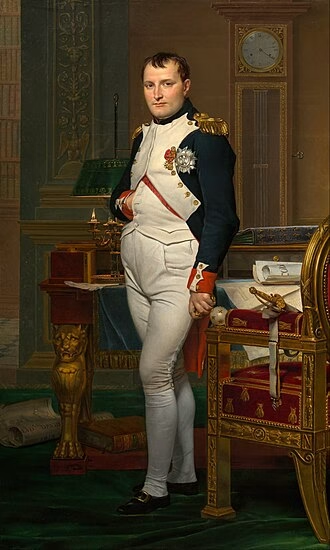
The city of Bordeaux is nestled in the southwest of France. It might not be the first place you think of for revolutionary Jewish history. It was here, and in Paris, that a major change in Jewish life happened around the turn of the 19th century. This era began a shift for European Jewry from medieval marginalization to modern freedom. This change was driven by the powerful ideas of the French Revolution and one man’s great curiosity: Napoleon Bonaparte.
The engine of this transformation? A bold set of 12 questions.
Discover Jewish Heritage in Comfort and Style with Kosher Riverboat Cruise
Embark on a meaningful journey through history with Kosher River Cruises. Where every detail of your Jewish vacation is thoughtfully curated. Our Jewish cruises offer rich learning experiences along with luxury stays, fine kosher food, and daily religious services. Discover amazing places and strengthen your bond with Jewish heritage. Enjoy the comfort and charm of life on Jewish cruises. Let this be more than a getaway—make it a journey of discovery and inspiration.
Discover Jewish Heritage in Comfort and Style with Kosher River Cruises
Embark on a meaningful journey through history with Kosher River Cruises—where every detail of your Jewish vacation is thoughtfully curated. Our Jewish cruises combine enriching educational experiences with luxurious accommodations, fine kosher cuisine, and daily religious services. Explore remarkable destinations as you deepen your connection to Jewish heritage, all while enjoying the warmth and elegance of life aboard a premier riverboat. Let this be more than a getaway—make it a journey of discovery and inspiration.
The Emancipation of the Jews: More Than a Word
The term “Emancipation” describes how Jews moved to modern citizenship. But it’s not quite right. It borrows its language from the context of slavery. Notably the emancipation of African-Americans and Russian serfs. Jews weren’t slaves, but they faced centuries of laws and social rules. These restrictions made it hard for them to fully join European society.
In pre-modern France, Jews faced many challenges. They had limits on where they could live. They were excluded from universities and many trades. They also felt pressure to convert to gain basic civil rights. The idea of a secular, equal citizenship had no place in the old feudal structures. But this all changed—at least in principle—with the outbreak of the French Revolution in 1789.
The Declaration That Changed Everything
In August 1789, the French National Assembly passed the Declaration of the Rights of Man and of the Citizen. This declaration made a bold statement: all men are born free and equal in rights. This groundbreaking document reflected the ideals of the American Bill of Rights. It also sparked hope for marginalized groups in France, like Jews and women.
The declaration claimed everyone was equal, but that wasn’t true right away. France’s Sephardic Jews—mostly French-speaking and acculturated—were granted citizenship in 1790. Their Ashkenazi counterparts in the northeast had to wait another year. Yet even with emancipation formalized, tensions simmered.
The Backlash and Napoleon’s Intervention
As Jews began participating more fully in economic life, old prejudices resurfaced. In places where Jews faced long-standing restrictions, they now entered new jobs and markets. Their strong literacy and numeracy skills, developed over many generations, helped them succeed. This led to widespread resentment, especially among the non-Jewish population in Ashkenazic regions.
By the early 1800s, complaints reached the ears of Napoleon himself. Napoleon was a strategist. He aimed to ease social tensions and understand how the newly freed people saw France. Were Jews really blending into French society, or were they keeping a distinct identity that resisted fitting in?
His solution was bold: call for a Jewish representative body, like the ancient Sanhedrin.
Reviving the Sanhedrin
In 1806, Napoleon called the Assembly of Notables. It grew into the Grand Sanhedrin in 1807. Rabbi David Sinzheim led this remarkable gathering of Jewish leaders from all over Napoleonic Europe. Their task? Answer twelve key questions about Jewish integration into French society.
These weren’t just theological musings, they were a litmus test for citizenship.
Napoleon’s Twelve Questions
The questions fall into three main themes. Family and religious practice, civic loyalty, and community structure
- Do Jews practice polygamy? Napoleon sought to determine how closely Jewish domestic life aligned with French norms. The answer was simple: no. Polygamy had been banned among European Jews since around the 11th century.
- Is divorce permitted in Judaism? Unlike the Catholic Church, Judaism allows for divorce. This difference was noted but not seen as an impediment.
- Can Jews marry non-Jews? This was the most difficult to answer. Jewish law forbids intermarriage. But in reality, the community had no tools to prevent it in a secular society. The Sanhedrin offered a vague and evasive response.
- Do Jews consider Frenchmen their brethren or strangers? The expected and delivered answer was that Jews considered Frenchmen their brothers.
- Do Jews born in France see it as their homeland, and will they defend it? This question was crucial. Napoleon needed assurance that French Jews would remain loyal. Especially in the event of war with the German states.
- Do Jews obey the laws of France? The Sanhedrin confirmed that Jewish citizens were bound to obey French law.
7–9. Who appoints rabbis? Do rabbis have authority or police power? Must Jews obey rabbis? These questions examined whether Jewish communities functioned as a state within a state. The answers emphasized that while rabbis held moral and religious authority. They had no legal or political power under French law.
10–12. Are Jews obligated to engage in money-lending? Are they free to choose any occupation? Long accused of usury, Jews clarified that they were not bound to financial trades. They welcomed equal opportunity in all professions. Provided such access was granted by society.
The Impact of the Sanhedrin’s Answers
The Sanhedrin answered just as Napoleon wanted. They showed strong loyalty to France and wanted to fully integrate into society. But this public declaration came with a cost. Some critics, both past and present, say that Jewish leaders tried too hard for equality. They think this led to losing some of their uniqueness.
Indeed, their admiration for Napoleon bordered on worshipful. A medallion from that time shows Napoleon as Moses. He hands the Ten Commandments to a kneeling Jew. It’s a powerful image. It shows how French Jews embrace modern life but also highlights their complex situation.
Legacy of the Sanhedrin
Napoleon’s questions and the Sanhedrin’s answers shaped modern Jewish life well beyond France. The model of integration balanced religious identity with national loyalty. This approach became the blueprint for Jewish communities in the Western world.
Still, these transformations were not without their contradictions. Napoleon later brought back restrictions on Jews. So, Jewish communities in Eastern Europe remained more skeptical about modernity’s promises.
The Sanhedrin is a key moment. It marked a formal, public talk between a European state and its Jewish citizens. This discussion focused on what it means to belong.
Conclusion: A Step Into Modernity
Napoleon’s twelve questions started as a political move. However, their answers helped pave the way for Jewish emancipation across Europe. Cities like Bordeaux and Paris began a new chapter. Jewish life entered modernity, but it still faced challenges. What did it mean to stay Jewish in a fast-changing world?
Walking the streets of Bordeaux or studying Sanhedrin debates today isn’t just about history. It is a journey into the very roots of modern Jewish identity.
Discover the Legacy of Our People Through Kosher Riverboat Cruise

Exploring Jewish history helps us understand our roots. It also strengthens the bonds that connect us. Kosher Riverboat Cruise offers more than just a Jewish vacation. It’s an opportunity to walk in the footsteps of our ancestors while enjoying the finest glatt kosher accommodations at sea. Join us for an unforgettable Jewish cruise. Here, tradition, discovery, and community unite for a meaningful journey.

He is a scholar known for his sophisticated yet accessible lectures on Jewish history, watched by thousands of viewers daily on YouTube. The author of seven books on Jewish history and thought, he earned his PhD from the University of Toronto and held visiting and post-doctoral positions at Harvard, Cornell, Oxford and the Hebrew University of Jerusalem.


