In November 1570, a powerful earthquake hit Ferrara, northern Italy. The physical damage was severe, but the long-term effects on Jewish thought were even greater. This event sparked a significant change in rabbinic scholarship, reshaping Jewish intellectual history.
At the heart of this change was Azariah de’ Rossi, a scholarly Jewish figure. His response to the disaster helped guide Jewish thought into a new era.
An Elevated Approach to Jewish Cruises
If you want to explore Jewish history while traveling, kosher river cruises offer a great option. Guests enjoy luxury stays like kosher resorts, delicious kosher meals, and engaging itineraries. Each glatt kosher tour aims to create an inspiring and unforgettable Jewish vacation.
Who Was Azariah de’ Rossi?
Azariah de’ Rossi was born around 1511 in Mantua. He lived most of his life in northern Italy. His journey included cities like Venice, Ancona, Bologna, and Ferrara. His family has roots in Italy that go back centuries. They believe their ancestors came from the Land of Israel during the Roman exile under Titus.
De’ Rossi wasn’t a groundbreaking thinker at first, but he was very literate and knew Jewish manuscripts well. He lived during a tough time for Italian Jews, especially after the papal expulsions of 1569. Many communities were displaced. However, Ferrara stayed a rare center for Jewish stability and learning. This allowed de’ Rossi to keep working on his scholarship.
He maintained a family life—referencing a wife, daughter, and grandson—but left few personal details. His legacy would instead be defined by his intellectual pursuits.
What Role Did Censorship Play in His Scholarly World?
The invention of the printing press changed Jewish learning. Texts became more accessible than ever. This rise in printed material caught the attention of Church authorities. Most especially concerning works like the Talmud.
De’ Rossi likely served as a Jewish censor and bibliophile. He helped review and modify texts to meet Church rules. Many Jewish printers practiced self-censorship to protect their investments and avoid bans.
This role plunged De’ Rossi into a wealth of Jewish literature. It sharpened his critical awareness of texts and their historical context. These skills later influenced his most important work.
What Happened During the Earthquake of 1570?
On November 18, 1570, a massive earthquake hit Ferrara. Accounts from that time describe widespread destruction and fear. Residents fled the city and lived in open fields for weeks because of ongoing aftershocks.
This displacement led to a unique social environment. Jews and Christians, along with scholars and theologians, shared space and ideas. They engaged in conversations that daily life often didn’t allow.
For Azariah de’ Rossi, this temporary upheaval became an intellectual turning point.
How Did Interfaith Encounters Change His Thinking?
During his weeks outside Ferrara, de’ Rossi talked with Christian theologians and scholars. He learned about classical texts, historical methods, and scientific ideas from Renaissance thinkers through these discussions.
Sometimes, he recognized familiar material—texts he knew in Hebrew or Jewish tradition. His Christian peers thought these texts only existed in Greek or Latin. These talks made him believe that Jewish sources should be studied in a broader historical and cultural setting.
A key outcome of these meetings was his role in sharing the Letter of Aristeas, an important account of the Septuagint’s translation. This work would later be significant in his writings.
What Is Me’or Einayim and Why Was It Revolutionary?
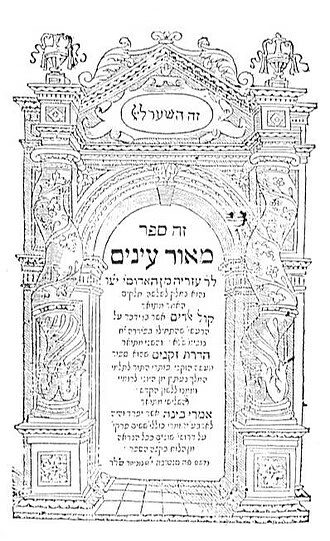
In 1573, Azariah de’ Rossi published Me’or Einayim, or “The Enlightenment of the Eyes.” This work marked a clear break from traditional rabbinic scholarship.
The book includes:
- A Hebrew treatment of the Letter of Aristeas
- A scientific and philosophical essay on earthquakes titled Kol Elohim (“The Voice of God”)
- Critical discussions of chronology, history, and natural science
De’ Rossi didn’t just follow traditional rabbinic commentary. He looked at Jewish texts with science, Greco-Roman history, and Renaissance scholarship. This method challenged old beliefs and brought historical criticism into Jewish study.
Was Azariah de’ Rossi the First “Modern” Jewish Thinker?
Earlier Jewish texts, like the Talmud, focused on observation and logic. However, de’ Rossi’s work showed a clear post-Renaissance view. His scholarship accepted outside knowledge as useful for understanding Jewish tradition.
Because of this, he is often seen as a forerunner to modern Orthodox and historical views on Judaism. He connected traditional loyalty with open-mindedness.
How Did the Rabbinic World Respond?
The reaction to Me’or Einayim was deeply divided. Some top rabbinic leaders strongly opposed de’ Rossi’s methods. They worried that historical criticism and outside sciences might weaken religious authority. Among his critics were Rabbi Joseph Caro and Rabbi Jacob Emden.
Others, however, recognized the value of his approach. Rabbi David Gans was a skilled astronomer and scholar. He welcomed the mix of science and Jewish learning. This showed a rising openness to new ideas in some circles.
What Lasting Impact Did the Earthquake Leave on Jewish Thought?
The earthquake of 1570 did more than level buildings; it disrupted intellectual boundaries. De’ Rossi’s work helped initiate a lasting bifurcation in Jewish scholarship. One path focused on the internal text of Judaism. The other looked at Judaism in wider historical, scientific, and cultural contexts.
This second path later thrived in 19th-century movements like Wissenschaft des Judentums. It fundamentally changed Jewish academic study.
A moment of disaster sparked a major change in Jewish intellectual history.
From Reflection to Exploration Aboard Jewish Cruises

This journey through Jewish history is ending, but it leads to new ways to experience our heritage. A glatt kosher tour lets travelers explore history while honoring tradition. Jewish cruises make learning hands-on. They connect generations by traveling in ways that honor faith and legacy.

He is a scholar known for his sophisticated yet accessible lectures on Jewish history, watched by thousands of viewers daily on YouTube. The author of seven books on Jewish history and thought, he earned his PhD from the University of Toronto and held visiting and post-doctoral positions at Harvard, Cornell, Oxford and the Hebrew University of Jerusalem.