Part One — Where England Meets the Atlantic
Portsmouth — Setting Out
There is a special kind of magic in letting the sea do the stitching — turning separate islands and cities into one continuous story, port by port.
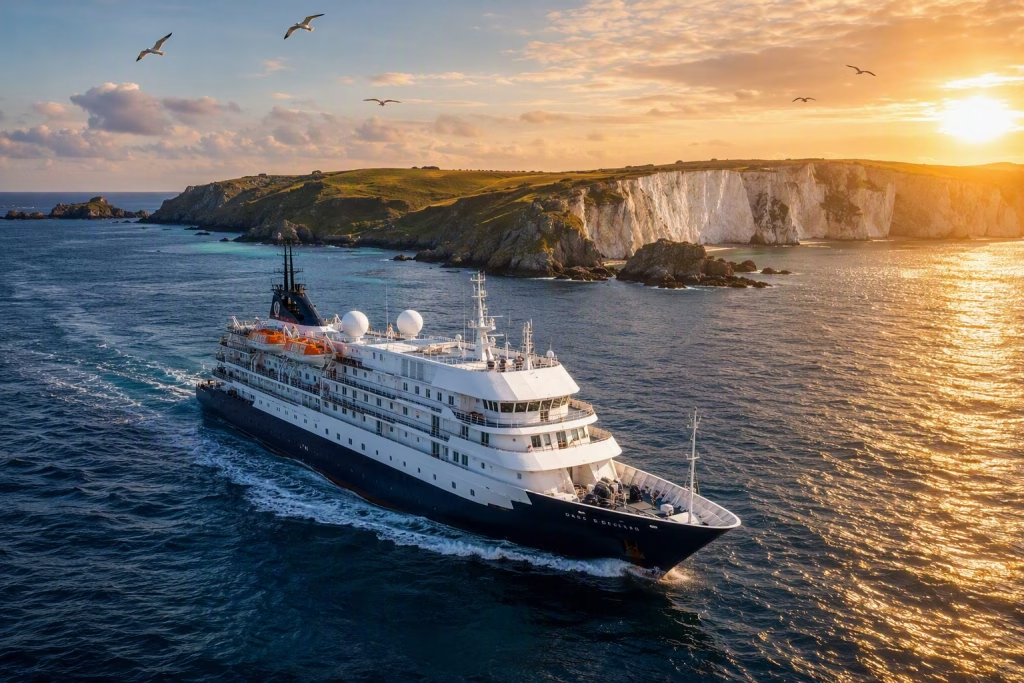
Diane and I boarded in Portsmouth with that particular excitement you only get at a harbour. Salt hung in the air, gulls wheeled overhead, and beyond the breakwater was the promise of somewhere else.
For me, there was something else in that moment.
The sea has been part of my working life for almost three decades. Since 1997 I have been involved in catering at sea, and over the years I have come to know the particular rhythm of life aboard a ship — the kitchens, the dining rooms, the endless planning and the extraordinary effort required to make hospitality appear effortless.
This time, however, Diane and I were passengers.
That felt rather different.
Portsmouth is a city that has always looked towards the sea. For centuries its harbour has been the gateway through which sailors, explorers, merchants and naval fleets have departed for distant horizons. The historic dockyard still carries that sense of adventure. Nelson’s HMS Victory, the Mary Rose and the great naval buildings remind visitors that the history of Britain has often been written from the deck of a ship.
But my departure was rather more leisurely.
As the ship eased away, the familiar outlines of the harbour slowly diminished. The naval docks became smaller, the buildings blurred into the haze, and Portsmouth gradually became a line on the horizon.
I found myself thinking about how much of my own life had been shaped by hospitality and by the sea.
I am the third generation of my family in the food-service industry. Long before river cruising and catering at sea became part of my life, I was running an 80-bedroom oceanfront kosher hotel in Brighton in the 1970s.
That was another era.
Kosher hospitality in Britain was very different then. The scale and sophistication of today’s programmes were still far in the future. Yet the fundamentals were exactly the same.
People wanted to be welcomed.
They wanted good food.
And above all, they wanted to feel that someone was looking after them.
Those lessons have stayed with me.
Out along the English coast, the famous chalk cliffs appeared and disappeared in the distance. There is something wonderfully hypnotic about the first hours at sea.
Ship time has its own rhythm.
Tea. Sea. Sky. Repeat.
And somewhere between the steady thrum of the engines and the long line of the horizon, I could feel the journey beginning to settle into place.
A Taste of Portsmouth — Hampshire Apple Cake
The countryside around Hampshire has long been associated with orchards and apples, so an apple cake seems an appropriate way to begin our culinary journey.
Hampshire Apple Cake
Ingredients
- 225g plain flour
- 2 tsp baking powder
- 100g butter
- 100g sugar
- 2 eggs
- 3–4 eating apples
- 2–3 tbsp milk
- 1 tsp cinnamon
Method
- Peel and slice the apples.
- Rub the butter into the flour and baking powder, then add the sugar. Beat in the eggs and enough milk to produce a thick batter.
- Fold in half the apples and spread into a greased cake tin. Arrange the remaining apples on top and sprinkle with cinnamon.
- Bake at 180°C for approximately 40–45 minutes.
Guernsey — Beauty with a Shadow
Our first port was Guernsey, and immediately the mood changed.
The island has an almost storybook appearance. Granite cottages sit behind thick hedgerows, narrow lanes wind between fields and gardens, and the coastline is constantly revealing another little bay or rocky headland.
Yet Guernsey’s beauty carries a shadow.
It is impossible to explore the island without encountering reminders of the German Occupation during the Second World War. Bunkers and defensive structures remain scattered across the landscape, sometimes appearing almost incongruously beside peaceful fields and beaches.
The German Occupation Museum brings those years into sharp focus.
Inside, the grand events of the war become much smaller and more personal: rationing, restrictions, fear, uncertainty and the daily struggle to maintain some kind of normal life.
I found myself thinking particularly about those who had sought refuge from Nazi persecution, including Jewish refugees who had managed to escape the continent.
For Diane and me, Jewish history is never entirely abstract.
We made Aliyah to Israel in the 1980s, but Britain remained deeply woven into our lives. My own career continued to take me back to Britain, including 26 years of running a Pesach programme here.
Those years taught me something about Jewish communities that museums alone cannot convey.
Jewish life is sustained not simply by buildings and institutions, but by people — by families, meals, celebrations, traditions and the willingness of one generation to pass them on to the next.
History on Guernsey isn’t locked away in a textbook. It is still embedded in the landscape.
Afterwards, I walked along the shoreline.
The wind was strong, the sea restless, and gradually the heaviness of the museum began to lift. There is something restorative about walking beside the sea. It doesn’t erase history, but it gives you space to absorb it.
A Taste of Guernsey — Guernsey Bean Jar
Guernsey’s traditional bean jar is a slow-cooked dish of beans, vegetables and meat. It is wonderfully appropriate island food — inexpensive, hearty and designed to provide sustenance through cooler weather.
Ingredients
- 250g dried haricot beans
- 250g dried butter beans
- 500g stewing meat
- 2 onions
- 2 carrots
- 2 leeks
- 2 potatoes
- 1 litre beef stock
- 2 bay leaves
- Thyme
- Salt and pepper
Soak the beans overnight.
Place everything in a large casserole, cover with stock and cook slowly at approximately 150°C for 3–4 hours, until the beans and meat are tender.
The result should be thick and comforting rather than soupy.
Sark — Where Time Slows Down
From Guernsey we sailed towards Sark, and suddenly the pace of life seemed to change.
Sark is famous for being car-free, and the absence of traffic is one of the first things you notice.
Instead there are bicycles, tractors, horse-drawn vehicles and people walking along quiet lanes.
It sounds like a small thing, but removing cars changes the character of a place. You hear birdsong. You hear footsteps. You notice the hedges and wildflowers.
There is no need to rush.
Sark’s coastline is spectacular, with cliffs rising dramatically from the sea. The famous Sark cliffs provide extraordinary views across the Channel, while La Coupée, the narrow ridge connecting Sark with Little Sark, offers one of the island’s most memorable walks.
Standing there, with the sea on either side, the modern world seems remarkably distant.
Sark doesn’t overwhelm you with museums or grand monuments.
Instead, it gives you something increasingly precious:
space.
Space to walk.
Space to look.
Space to think.
Diane and I have spent much of our lives organising things for other people — hotels, holiday programmes, meals, cruises. There is a particular pleasure in being somewhere where nobody is asking you what happens next.
Sark seemed to understand that.
A Taste of Sark — Sark Cream Tea
The Channel Islands have a particularly strong tradition of cream teas, and on an island as peaceful as Sark, the ritual seems almost inevitable.
Scones
- 225g self-raising flour
- 50g butter
- 25g sugar
- 1 egg
- Approximately 100ml milk
- Pinch of salt
Method
- Rub the butter into the flour. Add sugar and salt, then mix in the egg and enough milk to make a soft dough.
- Roll out and cut into rounds.
- Bake at 220°C for approximately 10–12 minutes.
- Serve warm with jam and cream.
And, naturally, there is an argument to be had about the correct order of jam and cream.
Perhaps on Sark we should simply agree that, with views like these, it doesn’t really matter.
St. Mary’s — The Isles of Scilly
The next morning brought us to St. Mary’s, the largest of the Isles of Scilly.
If Sark felt peaceful, Scilly felt almost dreamlike.
The islands lie far out in the Atlantic, and their position gives them a character unlike much of mainland Britain. The climate is surprisingly mild, while the surrounding ocean gives the landscape an almost Mediterranean quality on a good day.
St. Mary’s is a place of rugged coastline, turquoise coves, wild flowers and open fields.
We walked along the cliffs, stopping repeatedly simply to look.
The colour of the water seemed almost impossible — deep blue in the distance, turquoise where it shallowed around the rocks.
Seabirds circled overhead, and the sound of the Atlantic accompanied us wherever we went.
There was no particular heritage site that demanded our attention.
And that was rather wonderful.
After the museums and the weight of history, St. Mary’s reminded me that travel doesn’t always have to be about seeing something.
Sometimes it is about having enough time simply to feel where you are.
We stopped.
We breathed.
We watched the sea.
And for a while there was nothing else to do.
A Taste of Scilly — Cornish-Style Pasty
The culinary tradition of neighbouring Cornwall naturally reaches into the Isles of Scilly, and a pasty makes an excellent companion for a day exploring the islands.
Pastry
- 500g plain flour
- 125g pareve margarine
- Cold water
- Salt
Filling
- 400g diced beef
- 2 potatoes
- 1 onion
- 1 small swede
- Salt and pepper
- Make a firm pastry and divide into portions.
- Roll each into a circle. Place the filling in the centre, season well, fold over and crimp the edges firmly.
- Bake at 200°C for approximately 45 minutes.
The beauty of the pasty is that it was designed to be practical: substantial food that could be carried easily by workers.
That idea of practical food has always interested me.
After three generations in food service, I have learned that some of the best dishes are not the most elaborate ones. They are dishes that understand their purpose.
Food should feed people.
But at its best, it should also tell them something about where they are.
The Voyage Continues
Four ports, and already the journey has established its rhythm.
Portsmouth gave us the sense of departure.
Guernsey gave us history.
Sark gave us stillness.
St. Mary’s gave us space.
And behind all four was the sea — the constant thread connecting places that might otherwise seem very different.
For Diane and me, the voyage was already becoming more than a holiday.
It was a return to Britain, but not quite the Britain we had known before.
It was a journey through landscapes and communities that had shaped parts of our own lives.
It was also, inevitably, a journey through food.
That is difficult to avoid when food has been part of your family’s story for three generations.
And perhaps it is impossible for me to travel anywhere without wondering how a local dish might appear on a kosher table.
Ahead lies Waterford, where Viking history, Irish craftsmanship and another very different chapter of the journey await.
Beyond that will come Dublin, Belfast, the Isle of Man and eventually Scotland.
There will be Jewish history to discover.
There will be whisky.
There will be food.
There will be memories.
And there will be the sea, still doing what it has always done best.
Connecting one story to another.
The sea is still doing its stitching.
And the voyage continues.
See our next mail out for Part Two — Ireland, Memory and the Sea

Malcolm Green comes from three generations of caterers and has spent his life running kosher hotels, catering companies, destination weddings, and more than 70 glatt-kosher cruises around the world. Having absorbed global cuisines throughout his travels, he brings that experience into every menu he creates. Today, he oversees our kosher menu planning and food logistics, with all meals freshly prepared in our onboard kosher kitchens.